Chemical
front and flame front propagation in Hele-Shaw cells
View on-line
presentation on aqueous chemical fronts in Hele-Shaw cells
View on-line presentation
on gaseous flames in Hele-Shaw cells
Download movie on gaseous flames in Hele-Shaw cells (48
MB!)
It is well known that buoyancy and thermal expansion
affect the propagation rates and shapes of premixed gas flames. The
understanding of such effects is complicated by the large density ratio between
the reactants and products, which induces a baroclinic
production of vorticity due to misalignment of
density and pressure gradients at the front, which in turn leads to a
complicated multi-dimensional flame/flow interaction. The Hele-Shaw
cell, i.e., the region between closely-spaced
flat parallel plates, is probably the simplest system in which
multi-dimensional convection is present, consequently, the behavior of fluids
in this system has been studied extensively (Homsy,
1987). Probably the most important characteristic of Hele-Shaw
flows is that when the Reynolds number based on gap width is sufficiently
small, the Navier-Stokes equations averaged over the
gap reduce to a linear relation, namely a Laplace equation for pressure
(Darcy's law).
In this work, flame propagation in Hele-Shaw
cells is studied to obtain a better understanding of buoyancy and thermal
expansion effects on premixed flames. This work is also relevant to the study
of unburned hydrocarbon emissions produced by internal combustion engines since
these emissions are largely a result of the partial burning or complete flame
quenching in the narrow, annular gap called the "crevice volume"
between the piston and cylinder walls (see, for example, the text by J. B.
Heywood, 1988). A better understanding of how flames propagate in these volumes
through experiments using Hele-Shaw cells could lead
to identification of means to reduce these emissions.
Because of the very weak thermal expansion (typically
0.06%) caused by chemical reaction, the aqueous chemical fronts are affected by
buoyancy. This phenomenon has been studied in Hele-Shaw
cells, i.e., the gap between two closely
spaced flat parallel plates. Results show a new type of fingering mechanism not
present in non-reacting Hele-Shaw flows, which has
been identified as a surface tension effect, even though the reactant and
product solutions are miscible in all proportions. In fact, this wavelength is
almost independent of the front propagation speed (S or SL) and the
cell thickness (w). The only viable explanation of this, when compared to the
predictions of the Saffman-Taylor model, is a surface
tension at the interface whose magnitude is about 0.005 dyne/cm – about 14,000
times smaller than that of a water-air interface.
|
|
|
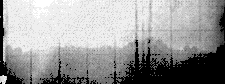
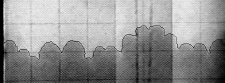
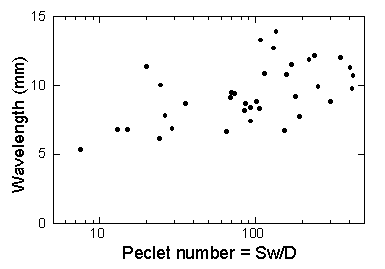
Left: images of upward propagating
autocatalytic fronts in a Hele-Shaw cell, cell
thickness (w) = 1.0 mm, SL = 0.17 mm/s. Upper image: 10 seconds after
initiation; lower image: after reaching quasi-steady
propagation condition. Width of cell is 200 mm. Right: effect of w and SL
(Peclet number = Sw/D, where D = mass diffusivity of
the stoichiometrically limiting reactant, IO3-)
on wavelength of initial disturbance.
Remarkably, the propagation rates of these wrinkled
buoyant fronts also conform to Yakhot's predictions
when a characteristic linear growth rate of the buoyancy-induced instability is
used to estimate the effective turbulence intensity (see second plot on this
page).
As a complement to the experiments on chemical fronts in
Hele-Shaw cells, premixed-gas flames in Hele-Shaw cells were also examined. Significantly,
wrinkling was observed even for downward propagating (buoyantly stable) flames and
flames having high Lewis number (diffusive-thermally stable). The burning rates
(ST) of these flames are quite different from their laminar,
unwrinkled values (SL). Values of ST/SL in the
quasi-steady stage were higher for upward vs. downward propagation, but only
weakly dependent on Lewis and Peclet number. Due to these wrinkling effects,
the front propagation rates in Hele-Shaw cells are
found to be always faster than the laminar
flame speed, typically by a factor of 3.These results show that even
for diffusively stable mixtures, at microgravity thermal expansion and
viscosity changes across the front will lead to flame instabilities.
These results also indicate that the behavior of flame propagation
in narrow channels such as crevice volumes in premixed-charge internal
combustion engines (the source of most unburned hydrocarbon emissions) may be
quite different from that inferred from simple laminar flame experiments.
|
|
|


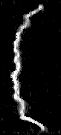

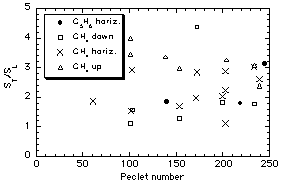
Characteristics of flames in Hele-Shaw
cells. Left: direct images (flames
propagate from left to right.) Cell width (vertical direction in these images)
39 cm. Cell length (horizontal direction in these images) 60 cm, but images are
cropped to show only flame front. Images from left to right: 7.2% CH4
in air, horizontal propagation; 7.1% CH4 in air, upward propagation;
7.1% CH4 in air, downward propagation; 3.0% C3H8
in air, horizontal propagation. Right: correlation of wrinkled front speed (ST/SL)
with Peclet number.
Not
proficient in English?